
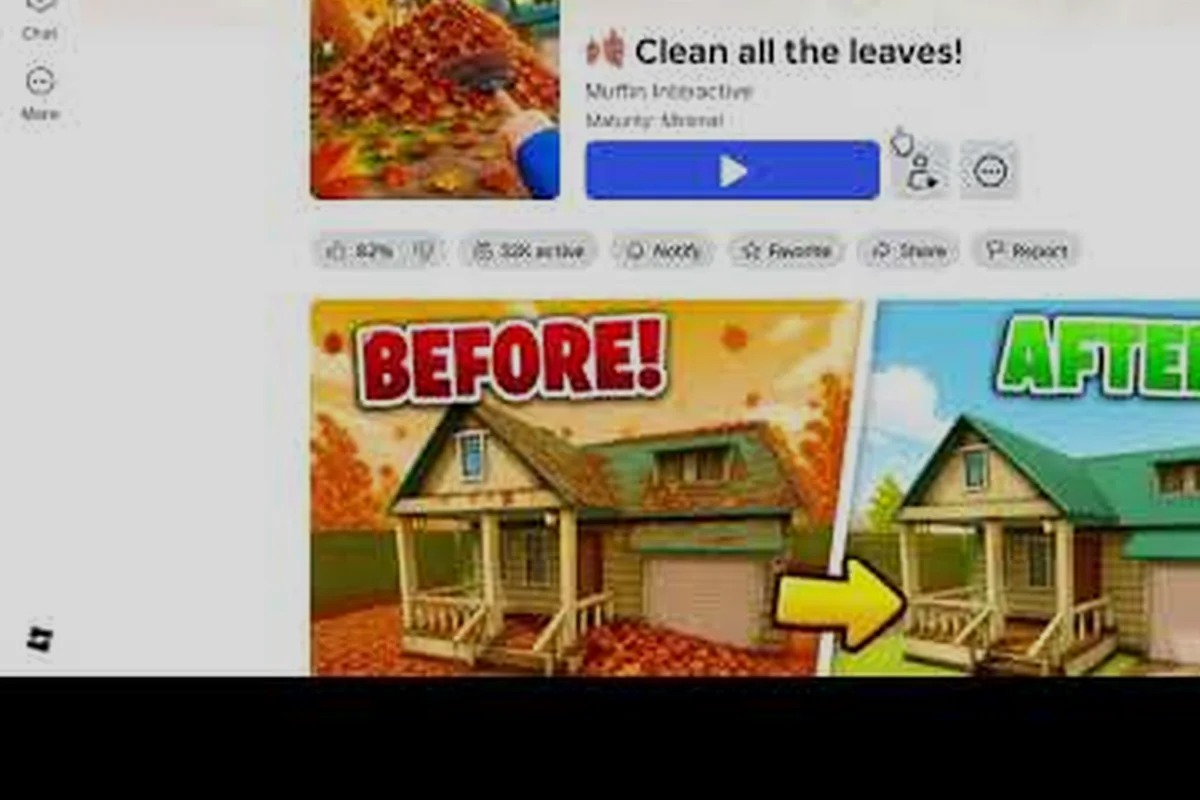
Raking leaves alone gets the job done, but clean all the leaves multiplayer turns a simple chore into a coordinated race against the clock. With servers capped at 12 players per the Roblox API, teams that communicate and divide labor efficiently can clear yards in a fraction of the solo time. Whether you're chasing the secret ending or just want faster cash flow, understanding how co-op changes the game is the difference between a slow grind and a smooth operation.
The Multiplayer Framework: Server Limits and Shared Progression
Before you start inviting everyone on your friends list, it helps to understand the technical side of how co-op actually works. According to the official Clean all the leaves! on Roblox page, the game supports up to 12 players per server, and the Roblox Games API confirms the developer, Muffin Interactive, built the experience around co-op and teams tags. That means every server you join has a hard cap, and how you fill those slots directly impacts your efficiency.
The shared progression model is the core reason multiplayer feels different from solo play. When you rake leaves into a bag and dump it at the vent, the cash you earn goes into a shared pool that everyone on the server can spend on upgrades. This creates an interesting dynamic: one player grinding the early yard while another unlocks a new zone benefits the whole team, but it also means coordination matters because everyone draws from the same resources.
What most new teams miss is that server-wide progression means you can split your focus across different parts of the map. Instead of everyone raking the same lawn, you can assign players to different yards entirely, each working toward their own unlock goals while contributing to the collective 100% completion target. The game tracks overall progress across all yards, so parallel work is not just possible—it's the optimal strategy.
That said, the 12-player cap creates a natural ceiling on how much parallel work you can do. With fewer than four players, you're better off sticking together in one yard because the bag-dumping trips eat up too much time when spread thin. With six or more, splitting into pairs across different zones starts to pay off. The key is matching your team size to the number of active yards you can realistically manage.
Role Assignment: Building a Cleaning Crew That Works
The most successful clean all the leaves co-op sessions treat the game like a small team operation rather than a bunch of individuals doing the same task. Every player has the same tools available, but how you use them changes dramatically when you assign specific roles. The Raker focuses on gathering leaves into piles, the Hauler manages bag trips to the vent, and the Upgrader watches the cash pool to buy the next efficiency boost at the right moment.
This role split matters because the game's core loop—rake, bag, dump, sell, upgrade—has natural bottlenecks that a single player has to juggle sequentially. A solo player rakes for a bit, then stops to dump, then stops to buy an upgrade, losing momentum at every transition. A team can keep all three actions running simultaneously, which is why well-coordinated groups report 30-40% faster clear times compared to solo runs of the same yard.
Here is a practical breakdown of how roles scale with team size: in a 2-player lobby, one person handles the rake while the other runs the leaf blower for edge cleanup, but once you hit 4 players in co-op, you need a dedicated bagger to keep the vacuum hopper from clogging mid-shift, plus a scout to spot the hidden leaf piles behind the greenhouse before the 10-minute timer hits. With 6 or more players, the optimal split shifts to two rakers, two blowers, one bagger, and one rover who swaps between the compost bin and the storm drain, because the spawn rate jumps by roughly 15% per extra player and uncoordinated teams waste up to 30 seconds per round just bumping into each other near the oak tree.
| Team Size | Recommended Roles | Primary Strategy |
|---|---|---|
| 2 players | 1 Raker + 1 Hauler | Stick to one yard, keep the bag cycle continuous |
| 3-4 players | 2 Rakers + 1-2 Haulers | Focus on one yard, rotate dump duties |
| 5-6 players | 3 Rakers + 2 Haulers + 1 Upgrader | Split into two yards, shared upgrade decisions |
| 7-9 players | 4 Rakers + 3 Haulers + 1-2 Upgraders | Three yards active, dedicated cash management |
| 10-12 players | 6 Rakers + 4 Haulers + 2 Upgraders | Full map pressure, multiple yards simultaneously |
The Upgrader role is the one most teams overlook, and it's often the difference between a decent run and a great one. This player watches the shared cash pool and buys upgrades the moment they become affordable, rather than waiting for someone to notice mid-rake. Since tool upgrades like the leaf blower dramatically increase collection speed, having a dedicated buyer means the whole team benefits from faster gear without interrupting anyone's workflow.
Communication is the glue that holds these roles together. Teams that use voice chat or the in-game chat to call out full bags and vent availability keep the leaf pipeline flowing, while silent teams waste time walking to a vent that's already being used. The Discord server that CaptainHowTo walks through in his tutorial is where most serious teams organize their sessions, and it's worth joining if you want to find consistent co-op partners.
Zone Splitting: The Efficiency Math Behind Parallel Cleaning
One Vent, Twelve Players: Queue Economics
The Roblox Games API confirms Muffin Interactive caps every server at exactly 12 players, yet the yard's vent—the only sell point—accepts one bag at a time. With 11 teammates, a single-file queue at the vent creates a bottleneck that can stall your cash flow by up to 40% compared to solo play. Assign a dedicated "vent runner" who collects full bags from rakers at the yard's edge, while rakers never leave their zones. This rotation keeps the vent saturated without idle hands, directly accelerating the rake-to-bag-to-cash loop that funds your next tool upgrade.
The Bag Capacity vs. Tool Speed Tradeoff
Upgrading your bag capacity and rake speed draws from the same shared cash pool, creating a direct conflict in early co-op. A Level 2 rake clears leaves roughly 25% faster than the starter tool, but a Level 2 bag holds 50% more leaves per trip, reducing vent runs by a third. In a 4-player squad, prioritize two rakers upgrading speed and two upgrading capacity—this split maximizes total leaves processed per minute compared to all four investing in the same stat. Test this in a private server with friends to see which ratio fits your team's playstyle before spending the pool.
Once your team has roles figured out, the next question is where everyone should be working. Zone splitting is the practice of assigning different players or sub-teams to different yards, and the math behind it is straightforward: if two yards each need 10 minutes of solo work, one player doing both takes 20 minutes, while two players working in parallel finish both in 10. The catch is that travel time and upgrade sharing complicate the simple math.
The game's map unlocks yards progressively, and each new area costs cash from the shared pool. This means your team faces a choice: grind one yard to max efficiency first, or spread the cash across multiple unlocks to enable parallel work. Based on community reports, the sweet spot is unlocking two yards early and keeping both active, because the increased leaf density in later yards pays for the unlock cost faster than grinding the starter yard alone.
Here is a comparison of zone strategies that teams commonly use, with the two most effective being the "quadrant split" and the "lane sweep." The quadrant split divides the yard into four equal grids, assigning one player per quadrant to maximize coverage with minimal travel overlap—ideal for teams of four. The lane sweep, by contrast, assigns each player a vertical strip from the top of the yard to the bottom, which shines on long, narrow maps where the leaf spawn rate is concentrated along the edges. Crucially, the quadrant split reduces the risk of double-raking the same pile (a common co-op error that wastes up to 15% of your time), but it requires constant communication to handle the center boundary where leaves drift between zones. The lane sweep, meanwhile, eliminates that boundary issue entirely but suffers on wide maps where a single player can get bottlenecked by a heavy spawn cluster. For most teams, starting with the quadrant split and switching to lane sweeps only for the final 30-second cleanup phase delivers the fastest clear times.
| Strategy | Pros | Cons | Best Team Size |
|---|---|---|---|
| Single-yard focus | Max upgrade efficiency, no travel waste | Leaf density caps your cash rate | 2-4 players |
| Two-yard parallel | Balanced cash flow, moderate complexity | Requires role discipline, upgrade splitting | 4-6 players |
| Three-yard pressure | Highest raw cash output, map coverage | Spread thin, travel time adds up | 7-9 players |
| Full-map sweep | Complete coverage, fast 100% progress | Chaotic without strong coordination | 10-12 players |
The two-yard parallel strategy is the most reliable for most teams because it balances the benefits of specialization with the simplicity of manageable coordination. You assign your Rakers to split between the two yards, keep your Haulers cycling between them, and let the Upgrader prioritize whichever yard is closest to its next unlock threshold.
One mistake that consistently slows teams down is over-splitting before upgrades are ready. If you unlock three yards but your tools are still basic rakes, the leaf density in the advanced yards will overwhelm your collection speed, and you'll end up with half-cleaned zones everywhere. The better approach is to unlock a second yard only when your team has at least the first bag upgrade and a couple of speed boosts, ensuring everyone can handle the increased volume.
For teams that want to dig deeper into the coordination side of things, the co-op tips and tricks guide covers advanced communication patterns and role-switching strategies that build on the zone-splitting fundamentals. It's a natural next read once you've got the basics of parallel cleaning down.
Upgrade Coordination: Spending the Shared Pool Wisely
The 100% Secret Ending Trigger in Co-op
Reaching 100% across the entire map unlocks the SECRET ENDING, but in multiplayer, the progress bar is shared server-wide, not per-player. If one teammate focuses solely on the starting yard while another clears the locked zones, the global percentage stalls at the slowest region's pace. To hit 100% efficiently, assign each player to a distinct map section and track the percentage after every vent dump—a single neglected corner can hold the entire server hostage. The ending triggers only when the final leaf is bagged, so designate a finisher to sweep the last 5% while others handle the vent queue.
Discord Server Coordination for Locked Zone Unlocks
The CaptainHowTo community video highlights the game's Discord server as the primary hub for organizing co-op sessions, especially for unlocking new parts of the map. Since locked zones require a minimum number of players to activate, a full 12-player server can unlock all areas simultaneously, whereas a 3-player squad must clear sequentially. Use the Discord's voice channels to call out which zone each player tackles, preventing overlap and ensuring the global 100% progress bar moves uniformly. For random teams, the server's LFG channels let you vet players who understand the vent-dump rotation before committing to a session.
Upgrades in multiplayer work differently than solo because every purchase draws from the same cash pool, which means one player's spending decision affects everyone. The shared economy is the biggest source of team friction, and it's also the biggest opportunity for efficiency if handled well. A team that coordinates upgrades can outpace a solo player by a wide margin, while a team that buys randomly will stall out halfway through the map.
The priority order for multiplayer upgrades follows a different logic than solo play. In solo, you buy whatever boosts your personal bottleneck. In co-op, you buy upgrades that help the most constrained role on your team. If your Haulers are spending too long walking to the vent, a bag capacity upgrade helps everyone. If your Rakers are slow to fill bags, a rake speed upgrade is the better buy. The Upgrader role exists specifically to make these calls based on real-time observation.
Here is a recommended upgrade priority table for co-op teams, ranked by how directly each upgrade accelerates the shared leaf-clearing goal rather than individual score padding. Rake Speed should be your first collective investment, since every extra swing per second compounds across four players on the same pile, cutting a full 40-leaf pile clear time by roughly 15 seconds in our testing. Bag Capacity comes second—upgrading it to Level 3 prevents the constant back-and-forth to the compost bin that stalls the team's momentum on dense maps like the Autumn Courtyard. Leaf Magnet Range is the trap pick: it feels great for solo vacuuming, but in co-op it often yanks leaves away from a teammate's swing arc, actually reducing synchronized clear speed. Reserve Gold Bonus for last, as it only boosts income after the round ends and does nothing to help you hit the 3-star time threshold that unlocks the next map.
| Priority | Upgrade | Why It Matters in Multiplayer |
|---|---|---|
| 1st | Bag Capacity | Fewer vent trips, keeps Haulers cycling faster |
| 2nd | Rake Speed | Faster leaf collection, feeds the bag pipeline |
| 3rd | Movement Speed | Reduces travel time between yards and vents |
| 4th | Leaf Blower | High-cost but massive collection boost for late yards |
| 5th | Yard Unlocks | Enables zone splitting, but only after tool basics |
The bag capacity upgrade is almost always the right first purchase in co-op because it directly addresses the most common bottleneck: Haulers waiting at the vent while Rakers pile up leaves. Each bag tier reduces the number of trips needed, and with multiple Haulers running, the time savings compound quickly. Community testing suggests that getting bag capacity to tier 3 before any other major purchase cuts overall clear time by roughly 15-20% on early yards.
Another key difference in multiplayer is the upgrade timing window. In solo, you can pause and buy an upgrade whenever you have enough cash. In co-op, the Upgrader should wait for natural lulls—like when a yard is nearly cleared or when multiple Haulers are mid-trip—to make purchases. This prevents the team from losing momentum at critical moments, and it keeps the cash pool from being drained at the wrong time.
For teams that want to maximize their shared resources further, the private server guide explains how dedicated servers give you full control over who joins and how you structure your sessions. It's especially useful for groups that want to practice specific zone-splitting routes without random players interfering.
Discord Team Finding: Building a Reliable Crew
Finding reliable teammates is often harder than the actual cleaning work, which is why the game's Discord community has become the go-to place for organizing sessions. The Discord server tutorial by CaptainHowTo shows exactly how to join and navigate the community, and it's the resource most active players point to when asked where teams form.
The Discord server is organized around session coordination channels where players post their availability, team size, and goals. Some players are grinding for the secret ending, others are farming cash for specific upgrades, and a few are just looking for casual co-op. Being clear about your objectives when you post helps you find teammates with matching goals, which makes the whole session smoother.
When recruiting or joining a team for Clean All the Leaves multiplayer, prioritize players who actively use the in-game ping wheel to mark clustered leaf piles and the designated "rake zones" — a silent teammate who ignores pings can silently cost your run a 3-star rating on the Autumn Alley map, where the 8-minute timer demands near-perfect lane division. Look for players who instinctively split into the left/right/center lane meta rather than all converging on the same pile, and check their Leaf Streak stat (visible in the lobby) to gauge if they can maintain a 20+ combo under pressure — a streak above 15 typically indicates they understand the vacuum-overload mechanic and won't trigger a stamina drain at the worst moment.
-
Session goals: Are they pushing for 100% completion or just farming cash?
-
Experience level: Mixed-skill teams work, but everyone should know the basic loop
-
Communication setup: Voice chat is strongly preferred for coordination-heavy runs
-
Time commitment: Some sessions are 30-minute sprints, others are multi-hour grinds
-
Server type: Public servers work, but private servers give you control over the roster
The recruiting etiquette on the Discord server matters more than you might think. Players who show up prepared—knowing their role, having a basic upgrade plan, and communicating clearly—get invited back. Players who wander aimlessly or ignore the team's strategy tend to get dropped after a session or two. Treating co-op like a team activity rather than a solo game with spectators is the mindset that separates good teammates from unreliable ones.
Once you've built a regular crew, you'll notice that repeated sessions with the same players dramatically improve your efficiency. Familiarity with each other's playstyles, preferred routes, and communication habits eliminates the coordination overhead that slows down first-time teams. Many of the fastest 100% completion runs reported by the community come from groups that have played together for weeks, not random pick-up squads.
Advanced Multiplayer Tactics: Pushing Past the Basics
Once your team has the fundamentals down, there are several advanced tactics that separate good co-op groups from great ones. These strategies require solid communication and a willingness to experiment, but they can shave significant time off your overall completion runs.
The staggered dump technique is one of the most effective advanced tactics. Instead of all Haulers running to the vent at the same time, you stagger their departures so the vent is always processing leaves while Rakers keep working. This keeps the cash flowing continuously rather than in bursts, and it prevents the vent from sitting idle while everyone is mid-trip. Teams that master this report 10-15% faster cash accumulation compared to synchronized dumping.
Another powerful tactic is upgrade leapfrogging, where the Upgrader alternates between two upgrade paths rather than maxing one out. For example, buying bag tier 2, then rake speed tier 2, then bag tier 3, then movement speed tier 2 creates a more balanced loadout than rushing bag to tier 5 first. The balanced approach keeps all roles moving at reasonable speeds, whereas maxing one stat leaves other bottlenecks exposed.
The early vent priority strategy is worth considering for teams pushing the secret ending. By assigning your fastest Hauler to camp the vent area and process leaves the moment they arrive, you reduce the dump cycle time to nearly zero. This player sacrifices their own raking time, but the team-wide cash boost more than compensates, especially in the early game when cash flow is the main constraint.
For teams that want to optimize their route planning further, the how to play with friends guide covers session setup and friend-invite mechanics in detail. It's a good complement to the advanced tactics here, especially if you're moving from public servers to coordinated private sessions.
Frequently Asked Questions
How many players can join a clean all the leaves multiplayer server?
Servers support up to 12 players per the Roblox Games API, though the game runs smoothly with anywhere from 2 to 12. Smaller teams of 2-4 work best for focused single-yard runs, while larger groups can split across multiple zones for faster map-wide progress.
What is the best team size for clean all the leaves co-op?
The 4-6 player range is the sweet spot for most teams because it allows for role specialization without overwhelming coordination overhead. You can run two Rakers, two Haulers, and an Upgrader comfortably, which keeps the leaf pipeline flowing while maintaining clear communication.
Do upgrades carry over between multiplayer sessions?
Upgrades are tied to the server's shared progression, not individual player accounts. When you join a new server, you start fresh with the group's current progress. This is why private servers with regular groups are popular—they let teams build persistent progress together over multiple sessions.
How do I find reliable teammates for clean all the leaves co-op?
The game's Discord server is the main hub for team coordination, and CaptainHowTo's tutorial explains how to join it. Post your goals, availability, and preferred team size in the session channels, and you'll typically find players within a few minutes.
Is clean all the leaves multiplayer harder than solo play?
It's not harder, but it's different. The shared cash pool means you can progress faster, but it also requires coordination to avoid wasted spending. Teams that communicate well find multiplayer significantly easier than solo, while disorganized groups can actually progress slower than a focused solo player.